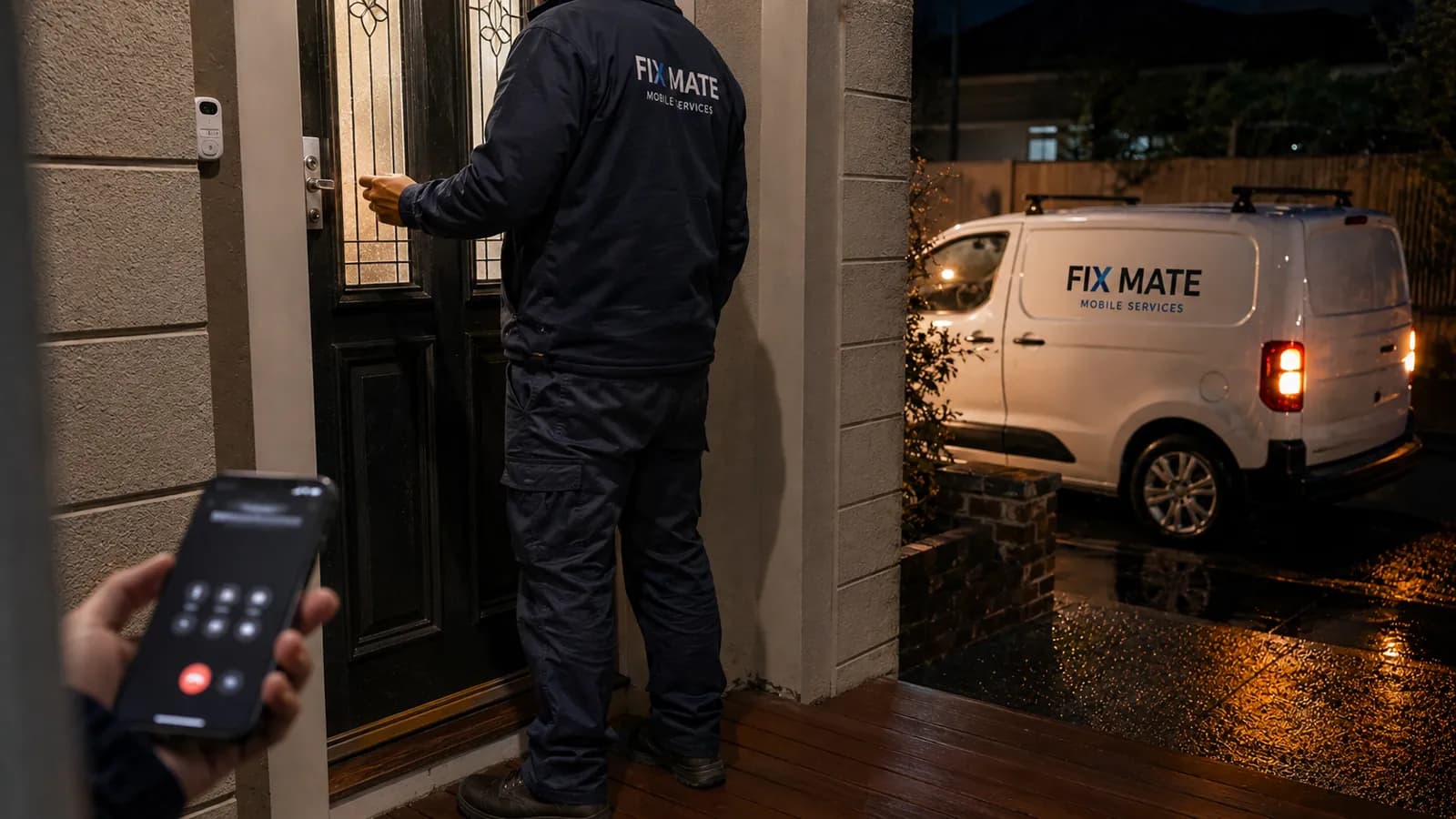
1. The call, and the four things we need
The call is short. It has to be, because you are standing outside and your phone is probably not fully charged. What we actually need is:
- Where you are — the suburb and the street, so we can work out which van is closest.
- Which door you are standing at. On a house that means front, back or garage. In an apartment it means the building's entrance or your own unit door, and those are genuinely different jobs.
- What happened. Keys inside, keys lost, key snapped in the lock, or the lock has simply stopped working.
- Whether anything makes it urgent — a child or a pet inside, a running car, a medical need, or a door that will not close at all.
Notice what is not on that list: your life story, or a decision about what to buy. The first call is about getting the right van to the right door.
2. You should be told where the nearest van is
This is the part worth insisting on. Ask where the closest technician actually is and roughly how long. A real answer names a suburb. An unreal answer is a flat number that would be the same whether you were in Southbank or Craigieburn.
If the window does not suit you, that is fine — you have lost a minute rather than an hour sitting on a step waiting for someone who was never nearby.
3. The ID check, and why you want it to happen
Before any door is opened you will be asked to show that you are entitled to be there. Photo ID with the address, a lease, mail addressed to you at the property, or a property manager who can confirm it over the phone.
If your ID is inside the locked property — which is often the case — say so early. It is a normal situation and there are other ways to establish the same thing.
4. The door gets opened, usually without damage
In the large majority of residential lockouts the lock is opened intact. That is not a favour; it is simply the faster and better outcome, and it leaves you with a working lock instead of a hole in the door.
Some locks genuinely cannot be opened without damage — certain high-security cylinders, and locks that are already broken or have a key snapped deep inside. Where that is the case you should hear it before work starts, along with what the alternative involves.
5. The cost conversation happens before, not after
You should be told the cost before anything begins. Not an estimate shouted through a door, and not a number that appears once the lock is already open.
There are no prices on this website, deliberately. A genuine figure depends on the lock, the door, the hour and where you are — and a number published on a page would be wrong more often than it was right. What we will do is give you a realistic range on the phone and confirm it in person.
The two things not to do while you wait
Do not break a window. It costs several times what a lockout does, and you will still need someone to secure the opening afterwards.
Do not attack the lock. Screwdrivers, credit cards and coat hangers turn a short visit into a lock replacement, and on a modern door they often damage the frame as well.
If there is a genuinely faster option in your situation — a back door, a laundry door, a neighbour with a spare — tell us on the phone and we will say so before anybody drives anywhere.